My research addresses the challenge of how technology interacts with our increasingly interconnected political environment to shape human security through theoretical frameworks grounded in international relations and feminist theories focusing on human rights, using mixed-methods and computational social science approaches.
Publications
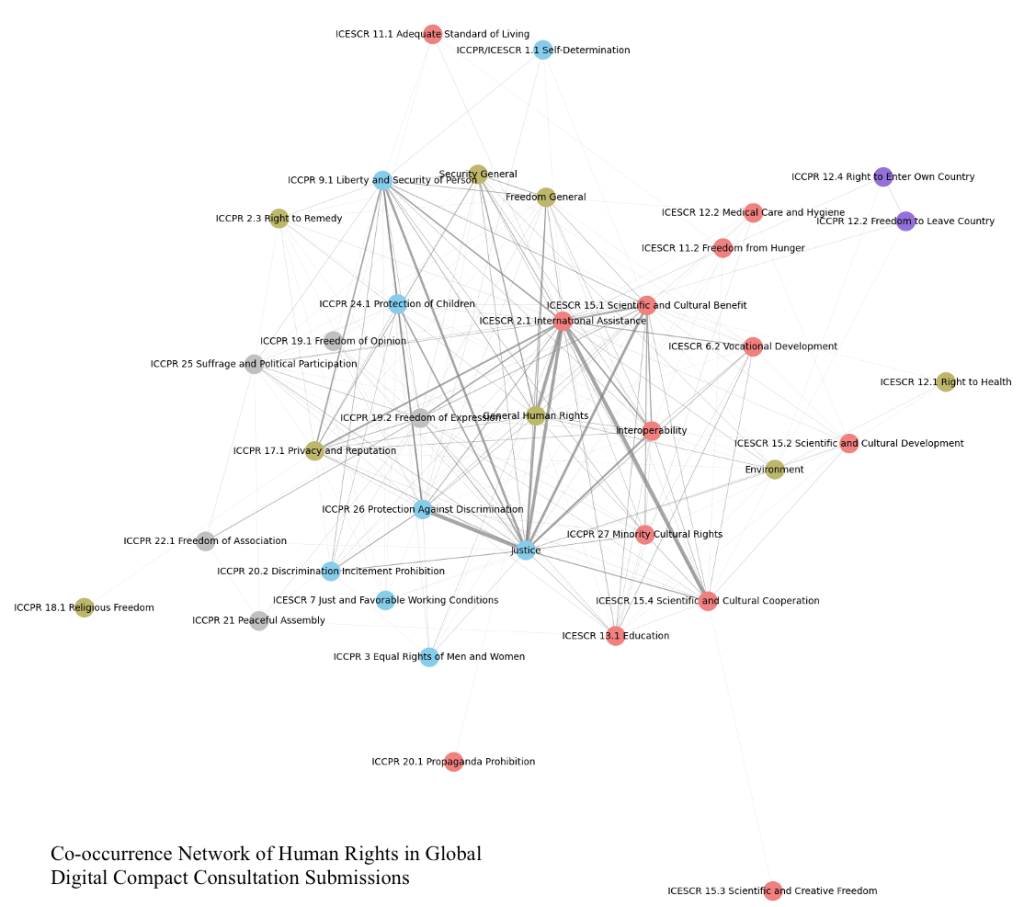
Morrell, S. (2025). Why (not) talk about human rights? Politics in the Global Digital Compact. Telecommunications Policy, 49(10), 1–28. https://doi.org/10.1016/j.telpol.2025.103077
Supplemental materials: https://github.com/smorrell6/Human-Rights-GDC
Morrell, S. (2024). Book Review: Gaming and Extremism: The Radicalization of Digital Playgrounds Edited by Linda Schlegel and Rachel Kowert. Journal for Deradicalization, 39, 159–172. https://journals.sfu.ca/jd/index.php/jd/article/view/915
Morrell, S., & Kosal, M. E. (2021). Military Deception and Strategic Culture: The Soviet Union and Russian Federation. Journal of Information Warfare, 20(3), 127–145. https://www.jstor.org/stable/27125003
Hutton, G., Morrell, S., & Hayes, J. (2017). Democracy and Progressive Modernity in Constructions of Community: Europe, the United States, and the Russian ‘Other’. In V. L. Birchfield & A. R. Young (Eds.), Diplomacy among the United States, the European Union, and the Russian Federation: Responses to the Crisis in Ukraine (pp. 95–118). Palgrave Macmillan Cham. https://doi.org/10.1007/978-3-319-63435-7_5
Public Scholarship
Morrell, S. (2025). “Human Rights in the Internet Engineering Task Force: Using Large Language Models and Network Analysis to Explore Norm Entrepreneurship”. The NULab for Digital Humanities and Computational Social Science. https://cssh.northeastern.edu/nulab/human-rights-in-the-internet-engineering-task-force/
Morrell, S. (2024) . “Multimodal Telegram Message Analysis”. The NULab for Digital Humanities and Computational Social Science. https://cssh.northeastern.edu/nulab/nulab-research-project-multimodal-telegram-message-analysis/
Supplemental materials: https://github.com/smorrell6/Multimodel-Telegram-Analysis
Morrell, S. (2023). “Mapping Extremist Discourse Communities on Telegram: The Case of the Russian Imperial Movement”. Global Network on Extremism and Technology. https://gnet-research.org/2023/09/18/mapping-extremist-discourse-communities-on-telegram-the-case-of-the-russian-imperial-movement/
Supplemental materials: https://github.com/smorrell6/Mapping-Extremist-Discourse-Communities-on-Telegram
Conference Presentations and Papers
Crooks, C.L., Morrell, S. (2025). Development of a Computational Framework for Assessing Coercive Control in Groups. In: Arabnia, H.R., Deligiannidis, L., Shenavarmasouleh, F., Amirian, S., Ghareh Mohammadi, F. (eds) Computational Science and Computational Intelligence. CSCI 2024. Communications in Computer and Information Science, vol 2506. Springer, Cham. https://doi.org/10.1007/978-3-031-95130-5_1
Morrell, S. (2025). Why (Not) Talk About Human Rights? Politics in the Global Digital Compact. 2025 APSA Annual Meeting, Vancouver, BC, Canada. https://doi.org/10.33774/apsa-2025-r5kbg-v3
Morrell, S. (2023). Mapping Extremist Discourse Communities on Telegram: The Case of the Russian Imperial Movement and Its Affiliates. 2023 American Political Science Association Annual Meeting, Los Angeles, CA. https://doi.org/10.33774/apsa-2023-zjrvt-v3
Morrell, S. & Kosal, M.E. (2019). Disinformation Campaigns and Strategic Culture: The Soviet Union and Russian Federation. 2019 International Studies Association (ISA) Annual Meeting, Toronto, Canada.
Works in Progress
“Grounding Classroom AI Policy in Ethics: A Student-Centered Dialogic Approach”. Accepted for presentation at the 2026 American Political Science Association Annual Meeting. Preprint available at https://doi.org/10.33774/apsa-2026-kmz64-v2.
“‘We are F-ING STORMTROOPERS’: Gamified False Heroism and Criminality in the U.S. Capitol Attack”. In draft, part of the dissertation Making the Internet Less Useful for Terrorists.
“Keeping Safe Spaces Safe: Exploring Community Management Strategies on Twitch”. In draft, part of the dissertation Making the Internet Less Useful for Terrorists.
 Sara Morrell